
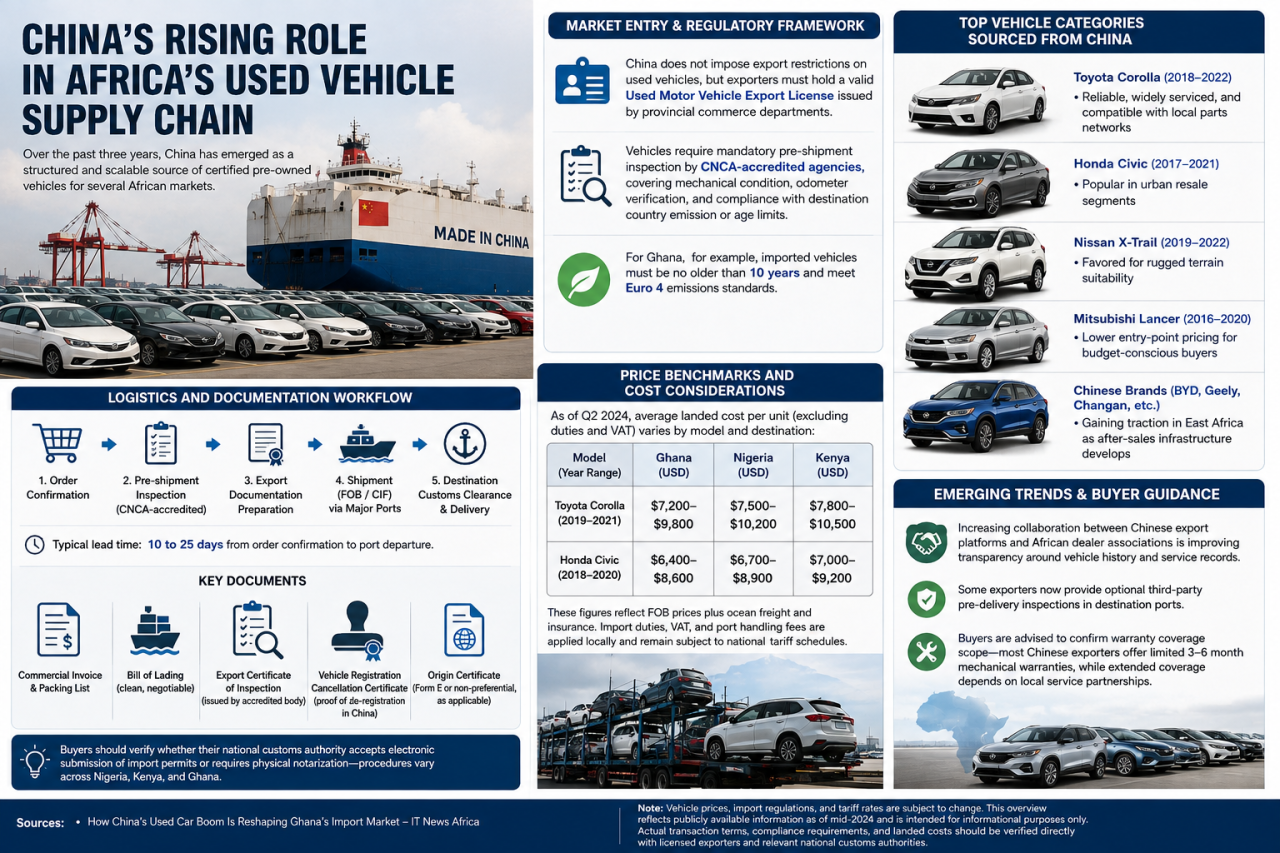
China’s Rising Role in Africa’s Used Vehicle Supply Chain
Over the past three years, China has emerged as a structured and scalable source of certified pre-owned vehicles for several African markets. Driven by domestic policy reforms—including the 2022 national pilot program for used car exports and standardized certification protocols—Chinese exporters now offer traceable, inspected, and documentation-compliant units to international buyers.
Market Entry and Regulatory Framework
China does not impose export restrictions on used vehicles, but exporters must hold a valid Used Motor Vehicle Export License issued by provincial commerce departments. Vehicles require mandatory pre-shipment inspection by CNCA-accredited agencies, covering mechanical condition, odometer verification, and compliance with destination country emission or age limits. For Ghana, for example, imported vehicles must be no older than 10 years and meet Euro 4 emissions standards.
Top Vehicle Categories Sourced from China
Japanese-brand models dominate outbound shipments due to high domestic ownership and strong residual value in African markets. Common models include:
- Toyota Corolla (2018–2022): Reliable, widely serviced, and compatible with local parts networks
- Honda Civic (2017–2021): Popular in urban resale segments
- Nissan X-Trail (2019–2022): Favored for rugged terrain suitability
- Mitsubishi Lancer (2016–2020): Lower entry-point pricing for budget-conscious buyers
Chinese-branded vehicles—such as BYD, Geely, and Changan—are gaining traction in East Africa, particularly where after-sales support infrastructure is developing.
Logistics and Documentation Workflow
Most transactions follow a CIF or FOB basis, with shipments routed via Tianjin, Shanghai, or Guangzhou ports. Typical lead time from order confirmation to port departure ranges from 10 to 25 days, depending on inspection scheduling and customs clearance at origin. Key documents include:
- Commercial Invoice & Packing List
- Bill of Lading (clean, negotiable)
- Export Certificate of Inspection (issued by accredited body)
- Vehicle Registration Cancellation Certificate (proof of de-registration in China)
- Origin Certificate (Form E or non-preferential, as applicable)
Buyers should verify whether their national customs authority accepts electronic submission of import permits or requires physical notarization—procedures vary across Nigeria, Kenya, and Ghana.
Price Benchmarks and Cost Considerations
As of Q2 2024, average landed cost per unit (excluding duties and VAT) varies by model and destination:
| Model (Year Range) | Ghana (USD) | Nigeria (USD) | Kenya (USD) |
|---|---|---|---|
| Toyota Corolla (2019–2021) | $7,200–$9,800 | $7,500–$10,200 | $7,800–$10,500 |
| Honda Civic (2018–2020) | $6,400–$8,600 | $6,700–$8,900 | $7,000–$9,200 |
These figures reflect FOB prices plus ocean freight and insurance. Import duties, VAT, and port handling fees are applied locally and remain subject to national tariff schedules.
Emerging Trends and Buyer Guidance
Increasing collaboration between Chinese export platforms and African dealer associations is improving transparency around vehicle history and service records. Some exporters now provide optional third-party pre-delivery inspections in destination ports. Buyers are advised to confirm warranty coverage scope—most Chinese exporters offer limited 3–6 month mechanical warranties, while extended coverage depends on local service partnerships.
Sources
- How China’s Used Car Boom Is Reshaping Ghana’s Import Market - IT News Africa
(Note: Vehicle prices, import regulations, and tariff rates are subject to change. This overview reflects publicly available information as of mid-2024 and is intended for informational purposes only. Actual transaction terms, compliance requirements, and landed costs should be verified directly with licensed exporters and relevant national customs authorities.)