
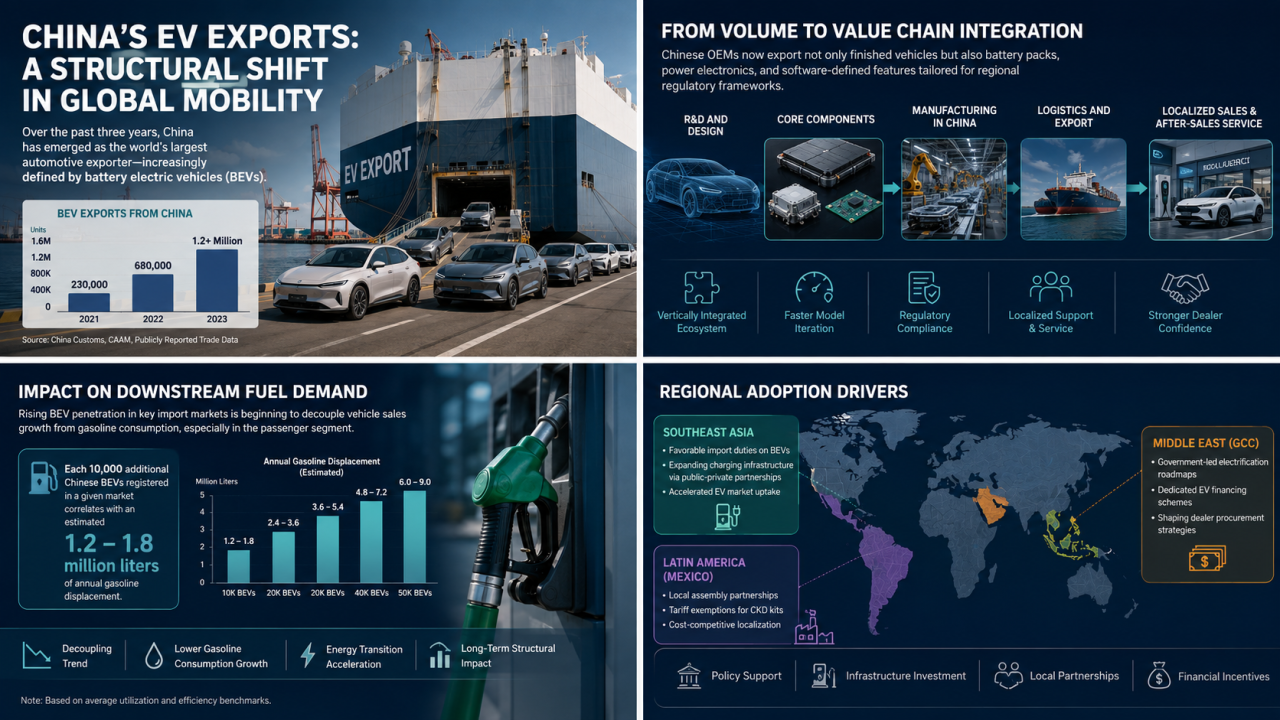
China’s EV Exports: A Structural Shift in Global Mobility
Over the past three years, China has emerged as the world’s largest automotive exporter — a position increasingly defined by battery electric vehicles (BEVs). According to publicly reported trade data, BEV exports from China rose from approximately 230,000 units in 2021 to over 1.2 million in 2023. This growth is not merely quantitative; it signals a reconfiguration of global vehicle supply chains and long-term energy demand assumptions.
From Volume to Value Chain Integration
Unlike earlier waves of Chinese auto exports — dominated by internal combustion engine (ICE) models targeting price-sensitive segments — today’s BEV shipments reflect vertically integrated production ecosystems. Chinese OEMs now export not only finished vehicles but also battery packs, power electronics, and software-defined features tailored for regional regulatory frameworks. This integration enables faster model iteration and localized after-sales support — critical factors for overseas dealers evaluating inventory turnover and service readiness.
Impact on Downstream Fuel Demand
A growing body of industry analysis suggests that rising BEV penetration in key import markets — including Thailand, Mexico, Russia, and parts of the Middle East — is beginning to decouple vehicle sales growth from gasoline consumption. While total transport fuel demand remains sensitive to freight, aviation, and legacy fleet usage, the passenger segment shows measurable elasticity: each 10,000 additional Chinese BEVs registered in a given market correlates with an estimated 1.2–1.8 million liters of annual gasoline displacement, based on average utilization and efficiency benchmarks.
Regional Adoption Drivers
Market receptivity varies significantly. In Southeast Asia, favorable import duties on BEVs — combined with expanding charging infrastructure funded via public-private partnerships — have accelerated uptake. In Latin America, especially Mexico, local assembly partnerships and tariff exemptions for CKD kits are enabling cost-competitive localization. Meanwhile, in select Gulf Cooperation Council (GCC) countries, government-led electrification roadmaps and dedicated EV financing schemes are shaping dealer procurement strategies.
Implications for International Dealers
For overseas dealers, this trend introduces both opportunity and complexity. On one hand, access to competitively priced, feature-rich BEVs expands product portfolio options and supports brand diversification. On the other, it requires updated technical training, certified diagnostics tools, and revised inventory financing models — particularly where battery health assessment and residual value forecasting differ markedly from ICE vehicles. Some forward-looking distributors are now collaborating with Chinese suppliers on joint certification pathways and warranty interoperability frameworks.
Supply Chain Adjustments Underway
Logistics providers report increased demand for temperature-controlled ocean containers and specialized EV loading protocols — reflecting heightened attention to battery safety and SOC (state of charge) management during transit. Port authorities in major receiving hubs, such as Rotterdam and Santos, have upgraded roll-on/roll-off (Ro-Ro) handling capabilities and introduced pre-clearance digital documentation systems to reduce dwell time for EV consignments.
Sources
- China’s EV export boom may be starting to reshape global gasoline demand - Energi Media — https://news.google.com/rss/articles/CBMifkFVX3lxTE9idVRtbTQtYkxCYmoweHBhSC1BM0lpNW9vNHpseE1MejRNRkFvN09OVmo5ZWJmWXExTzljTUtfNTJyZ0ZDZHNaZTNERnJqRTl2NHpJNDNJSENlWGpNeW53Zkx2X0lnaUluWnVXWDBRdzNSTXJyVDdlZlM4Zms3Zw?oc=5
Disclaimer: Vehicle pricing, import regulations, and tariff classifications referenced herein are subject to change and vary by jurisdiction. All figures and policy references are based on publicly available information as of mid-2024 and should be verified through official channels prior to commercial decision-making.