
Strong Growth and Geographic Shifts in China’s Passenger Vehicle Exports
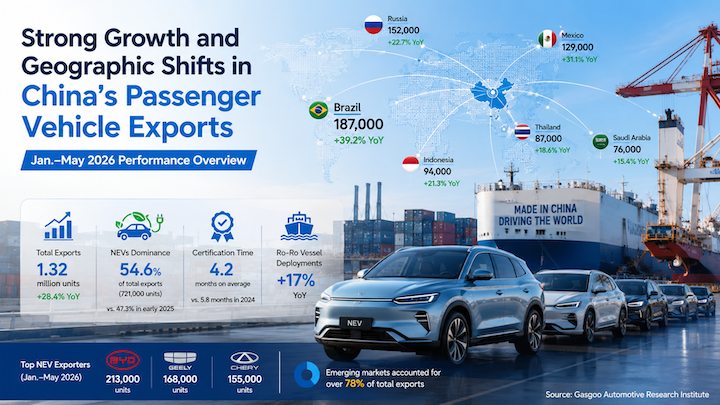
China’s passenger vehicle export performance from January to May 2026 reflects sustained momentum and evolving regional demand patterns. According to Gasgoo Automotive Research Institute, cumulative exports reached 1.32 million units during the period—a 28.4% increase year-on-year. This growth builds on infrastructure upgrades, streamlined customs procedures, and expanding overseas distribution partnerships.
Brazil Emerges as Top Destination
Brazil received the highest volume of Chinese passenger vehicles in the first five months of 2026, totaling 187,000 units. This represents a 39.2% rise compared to the same period last year. Factors contributing to this growth include tariff reductions under bilateral trade dialogues, localized after-sales support expansion by Chinese brands, and rising consumer preference for value-oriented, feature-rich models—particularly compact SUVs and battery electric vehicles (BEVs).
Russia followed closely with 152,000 units (+22.7% YoY), while Mexico imported 129,000 units (+31.1%). Other notable markets included Indonesia (94,000), Thailand (87,000), and Saudi Arabia (76,000). Collectively, emerging economies accounted for over 78% of total exports—underscoring continued reliance on non-traditional automotive markets.
NEVs Dominate Export Mix
New energy vehicles (NEVs)—including BEVs and plug-in hybrids—made up 54.6% of total passenger vehicle exports (721,000 units), up from 47.3% in early 2025. BYD led OEM rankings with 213,000 units exported, followed by Geely (168,000) and Chery (155,000). These three manufacturers collectively represented nearly 75% of all NEV exports during the period.
Most exported NEV models fall within the $15,000–$25,000 FOB range, targeting mid-tier segments in import markets. Battery supply chain localization—especially lithium iron phosphate (LFP) cell integration—has helped maintain cost competitiveness amid fluctuating raw material prices.
Logistics and Certification Trends
Port capacity utilization rose across major export hubs: Shanghai, Tianjin, and Guangzhou handled over 62% of outbound shipments. Roll-on/roll-off (Ro-Ro) vessel deployments increased by 17% YoY, supporting faster transit times to South America and the Middle East. Meanwhile, certification timelines for GCC, Mercosur, and ASEAN type approvals averaged 4.2 months—down from 5.8 months in 2024—thanks to standardized documentation templates and third-party verification partnerships.
Several Chinese OEMs now offer modular compliance packages—including localized infotainment language options, climate-specific cooling calibration, and right-hand-drive configurations—to accelerate market entry. Dealer training programs, delivered remotely or via regional hubs, are increasingly bundled into export contracts.
Outlook and Considerations for Importers
While growth remains robust, importers should monitor upcoming regulatory developments—including proposed EU carbon border adjustment mechanism (CBAM) extensions to automotive parts and tightening homologation requirements in select African nations. Currency volatility in key markets (e.g., BRL, MXN, SAR) also warrants hedging strategies when negotiating long-term supply agreements.
For dealers evaluating sourcing options, lead times for popular NEV models currently average 8–12 weeks from order confirmation, depending on destination port congestion and local certification status. Non-NEV models—including ICE sedans and MPVs—continue to serve niche demand in markets with limited charging infrastructure or fuel taxation policies favoring internal combustion engines.
Sources
- China's passenger vehicle export overview (Jan.-May 2026): Brazil leads overall丨Gasgoo Automotive Research Institute - Gasgoo
(Note: Prices, policies, and tariff information cited are time-sensitive and provided for general reference only. Actual terms depend on individual negotiations and official regulatory guidance at time of transaction.)